The Clayton Time Warp - July 30, 1936 "The [Two] Stop Lights"

![The Clayton Time Warp - July 30, 1936 "The [Two] Stop Lights"](https://storage.ghost.io/c/2f/30/2f30efdc-507a-4954-97c5-0bbc338ea133/content/images/size/w1200/2026/07/jpoLYtXX-1.jpg)
My name is Ben Chapman and I am a student of history and a professional archivist. I live in Clayton and I wanted to share stories about the history of Clayton. This local history column has two goals:
- Focus on the local events and figures in the town of Clayton.
- Examine an 'anniversary' event on the same date of publication.
Perhaps the greatest free resource for learning about Clayton history is the recently digitized "Clayton News" which has editions online from 1914 to 1969.
"The Stop Lights" - July 30, 1936
This first article comes from the Clayton News on July 30, 1936. This local newspaper was microfilmed by the Hocutt-Ellington Memorial Library and recently digitized by the University of North Carolina at Chapel Hill. On page six there is an article describing the first two traffic lights that were installed in the Town of Clayton.
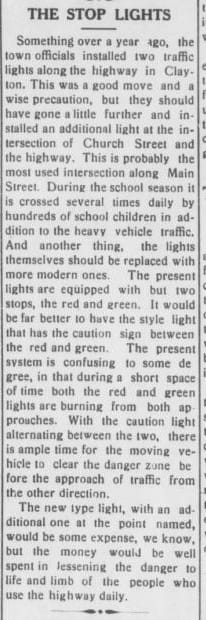
The stop lights were installed in 1935. A year later this was regarded as, "a good move and a wise precaution..." but this journalist had criticisms of these early traffic lights.
- Firstly, the journalist encouraged the installation of an additional light at Church and Main streets. He argued that it was necessary due to the fact that it's the most used intersection along Main street.
- Secondly, the journalist argued for the installation of "more modern" lights. The absence of a "caution" yellow light lead to confustion he argued, that could be avoided with the new type light.
Where Were "The [first two] Stop Lights"?
An earlier clipping from May 2, 1935 tells us exactly where these first two stop lights were installed; at the intersections of Main and O'Neal and Main and Lombard streets.
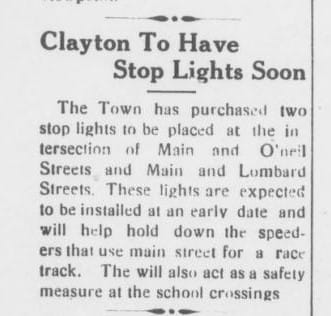
The stop lights at these two intersections that were installed to, "help hold down the speeders that use main street for a racetrack." And this early article referenced a desire to help students who needed to cross Main street in order to attend school.