August 13, 1936 - New Picture Show, A Pythian Picnic and A Piggly Wiggly Ad from 90 Years Ago

For the last few Clayton Time Warp columns we have been exploring what life was like in Clayton in 1936 using the recently digitized Clayton News. The project is focused on promoting this publicly available resource on Digital NC, Aug. 13, 1936.
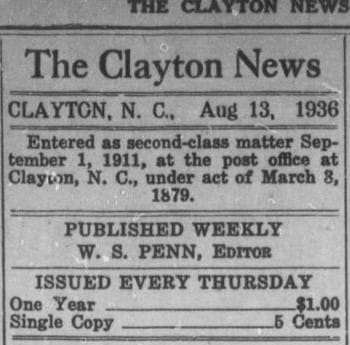
The main focus will be clippings that come from the August 13, 1936 edition of the Clayton News and the full newspaper is free on Digital NC. To give some context the Clayton Time Warp will "warp back" in order to explore the history of early theaters (spelled 'theatres' then) in Clayton.
This project will present these newspaper clippings as an opportunity for reflection as to what life was like some number of years ago.
Clayton To Have Picture Show - Wade Theatre
A 'Picture Show' theatre with "modern equipment" was front page news, but there is much more to this story than modern movies coming to Clayton, NC.
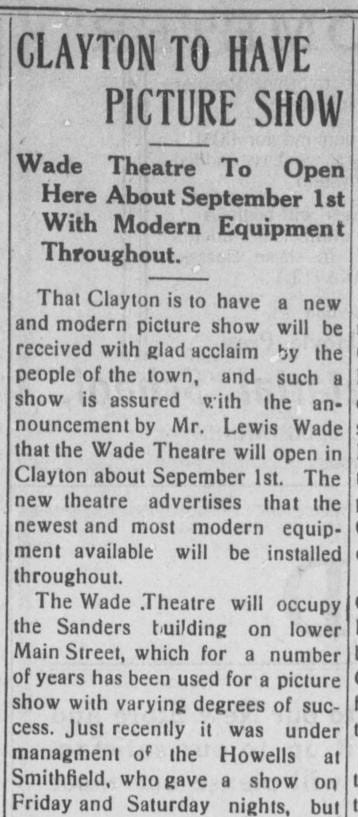
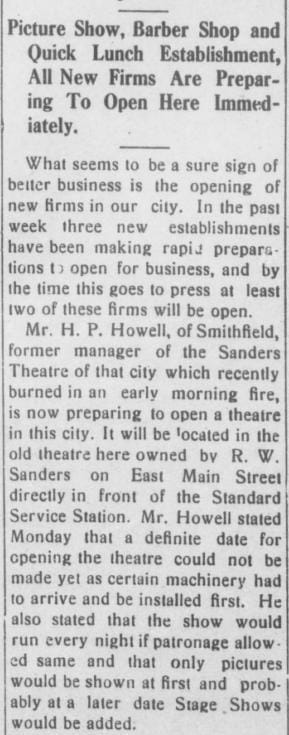
The location of this new theatre [sic] was the Sanders building on lower Main street where some picture shows were already held "with varying degrees of success." Until Lewis Wade stepped up in 1936 the Howells of Smithfield were putting on Friday and Saturday night shows, but these were not well attended.
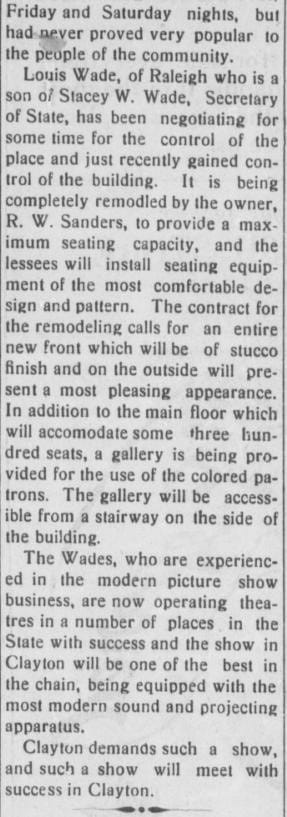
We know that Stacey W. Wade served as North Carolina Secretary of State since 1933 after previously serving as Commissioner of Insurance from 1921 to 1927. Of local interest is the entrepreneurial spirit of his son, spelled both Lewis and Louis in this article, who made arrangements to procure and install, "the most modern sound and projecting apparatus." We will learn more about the Wade Theatre in future editions of the Clayton Time Warp, for now I want to turn attention towards the preparations taht were being made by the building's owner in the remodeling of the "Sanders building."
Jim Crow Era Movie Theaters' Segregated Spaces - Galleries, Balconies, and a few notes on 'Challenging Historical Content'
In the Jim Crow era public spaces were segregated. When movie theaters became more common in the South often a seating area raised above other seating that was often only accessible from a separate entrance to the building was created.
A WRAL article from 2024 titled, "Forced into the Balcony" describes these segregated spaces focusing on Durham. Charlene Regester, associate professor of African American and Diaspora studies at UNC Chapel Hill said the segregated balcony area was often spoken about with slurs and disrespect. Balconies were given the name the 'buzzards roofs.' It was also called the 'crow's nest,' and I think some people even referred to it as the 'peanut gallery,'" said Regester.
In the 1930s in rural North Carolina vanishingly few if any stood against the prevailing segregationist social order. Thus, R. W. Sanders negotiated a contract to remodel an existing building at the behest of a business partner L. Wade who operated a number of movie theaters across the state of North Carolina as segregated spaces. They did what was not merely acceptable, but typical and legally enforced at that time. They weren't even the first theatre in clayton to enforce segregated seating by relegating black patrons to balcony seating.
Notes from Ben Chapman on Challenging Historical Content
With the Clayton Time Warp I will always aim towards sharing history with a straightforward and honest approach towards Clayton and NC's uncomfortable past. I acknowledge that it can be very challenging to confront this history. As a history professional I'm motivated by a general belief that it's important to refrain from 'glossing over' real history merely because it's challenging, uncomfortable or about unequal treatment.
As an anti-racist history professional I believe that we have a duty to teach about and learn from the inequities of the past. When we find historical examples of white supremacy we shouldn't look away or cover them up. It's tempting to share only the positive stories of triumph and civil rights heros, but the past is full of painful stories with lessons for us today.
Furthermore, as responsible citizens we should critically examine the ways in which white supremacist systems remain engrained within our culture, society, laws and local communities. If that idea is "critical race theory" then I encourage you to embrace critical race theory at the very least in your study and appreciation of history, but ideally also in your present life.
Warping Through Early Theaters in Clayton - 1914 to 1934
The fate of the self-proclaimed "King of the Movies" in Clayton, the many events held at the Palace Theatre,
Early Theatres in Clayton - The Many Events at the Palace Theatre(s), The Lyric Theatre and the Strand Theatre
The earliest mention of a theatre in the Clayton News is the "Palace Theatre", which appears in the first available edition of the Clayton News. We can learn a little bit from each of these clippings, and dive into anything that catches your attention with the links.
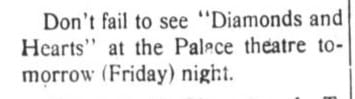
From the clipping above from December 3, 1914 we learn that the Palace theatre held a screening of "Diamonds and Hearts", an obscure silent film that you can not only read more about on Wikipedia, but also watch on YouTube. There's a lot more to learn about the Palace Theatre in dozens of clippings.
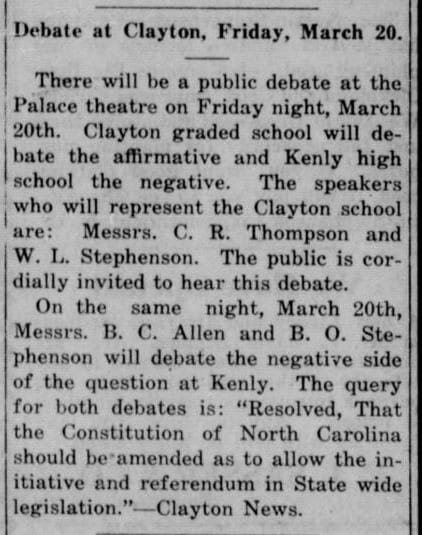
There are only three clippings that mention the Palace Theatre prior, and all are from the Smithfield Hearald. They were published between March 17th 1914 to October 30, 1914. The clipping below is the earliest mention of the Palace Theatre in any newspaper in Johnston County which the details a debate.
From the two clippings below, both from October 30, 1914 the Smithfield Herald notes another political event at the Palace Theatre in Clayton, J. W. Bailey speaking and the subsequent article mentions
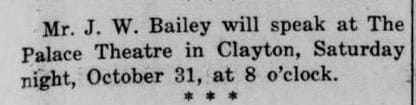
In 1914
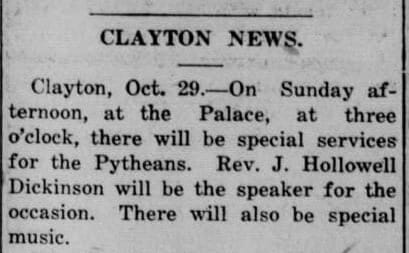
5 there were a
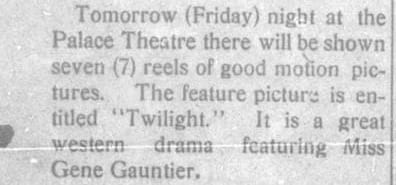
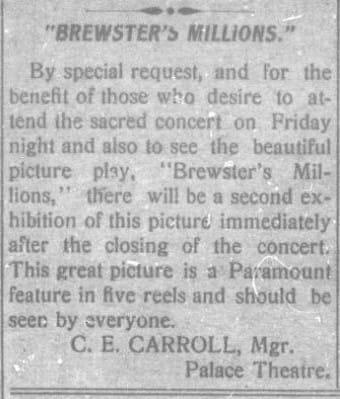
There are a handful of advertisements such was the one above for "Twilight", a silent film that you can read about on IMDB. The article below concerns an additional exhibition of the 1914 short film Brewster's Millions, also on IMDB.
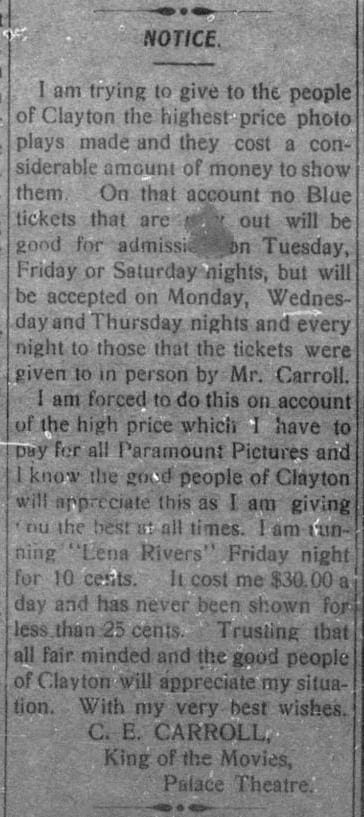
Among these movie advertisements are a "notice" from the manager of the Palace theatre "C. E. Carroll," who proclaimed himself the "King of the Movies".
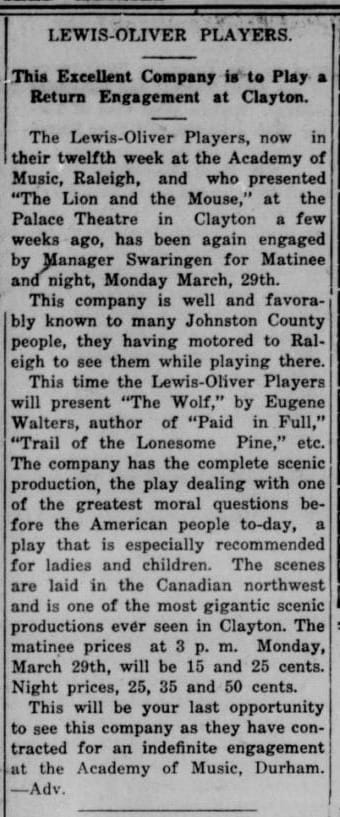
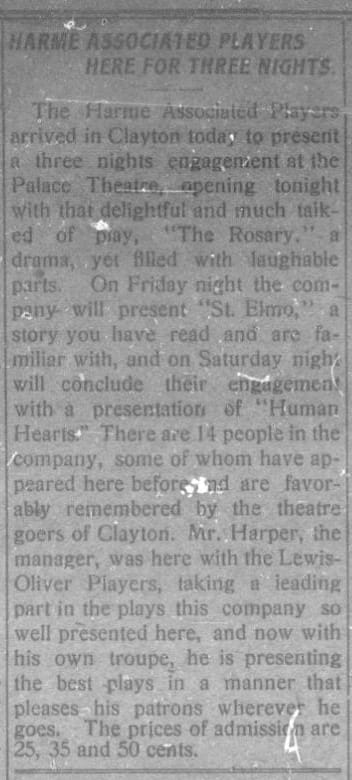
The King of Movies C. E. Carroll was even able to capitalize when a group of traveling "players" returned to Clayton to perform for three nights at the Palace Theatre. There were 14 people in the company and the journalist said that some of them had appeared in Clayton prior and were remembered favorably.
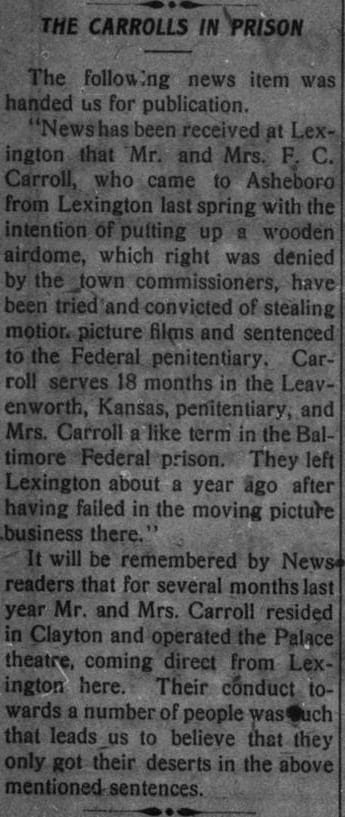
The reign of the King of Movies was not to last, and ended in 1917 when F. C. Carroll, the operator of the Palace Theatre was, "tried and convicted of stealing motion picture films and sentenced to the Federal penitentiary."
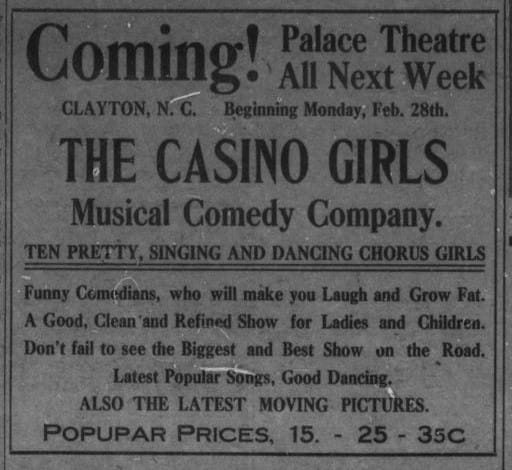
The Palace Theater Opens Under New Management in 1917
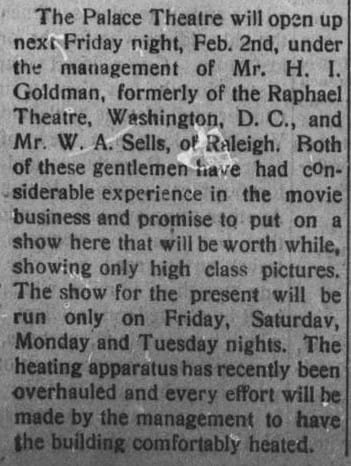
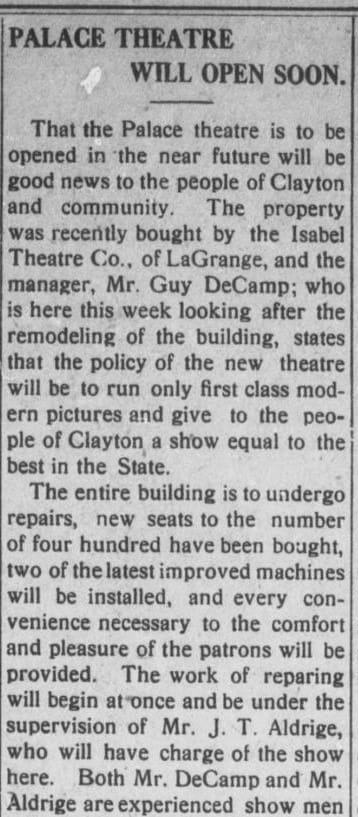
From the clipping below we learn that the Palace Theater came under new management in 1917. H. I. Goldman and W. A. Sells announced that they were running shows on Friday, Saturday, Monday and Tuesday nights and that they planned, "to have the building comfortably heated."
From the advertisement below we can read the specific run of show for 6 reels of silent film content for a big opening night. Each line, a story in an of itself.
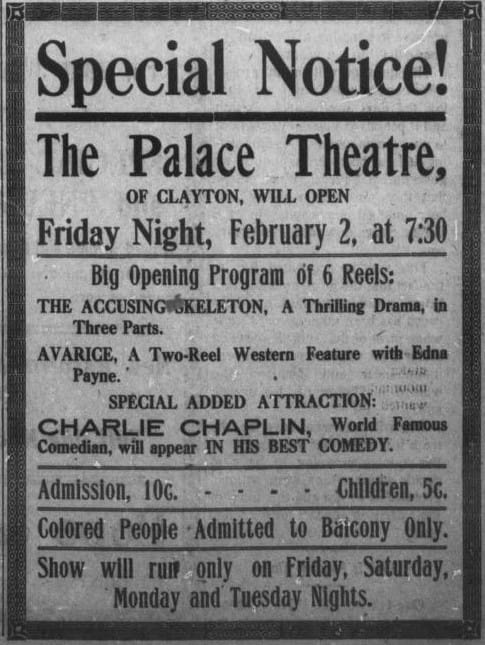
Special Notice!
The Palace Theatre,
of Clayton, WILL OPEN
The Accusing Skeleton, A Thrilling Drama, in three parts
The Accusing Skeleton - Progressive Silent Film List Article
Avarice, A Two-Reel Western Feature with Edna Payne
Avarice - IMDB Plot Article - from a Moving Picture World synopsis
Special ADDED ATTRACTION:
CHARLIE CHAPLIN, World Famous
Comedian, will appear IN HIS BEST COMEDY.
The Comedy isn't mentioned by name, so we are left to speculate which short was shown to this audience in 1917.
This news update and advertisement is the last mention of the Palace theatre in the Clayton News until 1920 when it once again comes under new ownership.
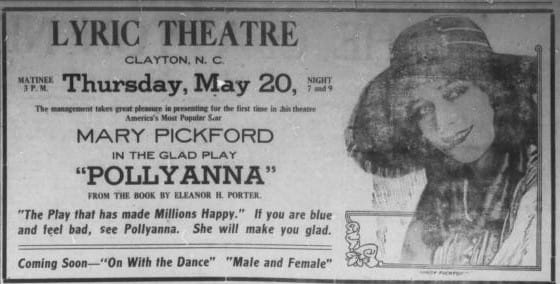
The Palace Theater Opens Under New Management in 1920
This third iteration of the
Finally, this clipping from 1934 brings us full circle.
Pythian Picnic
This is the first and not the last mention of the Knights of Pythias and the Pythian Home in Clayton. It is another example of a story that an entire book could be written about. In Clayton the orphanage was opened in 1910 and closed in 1969.
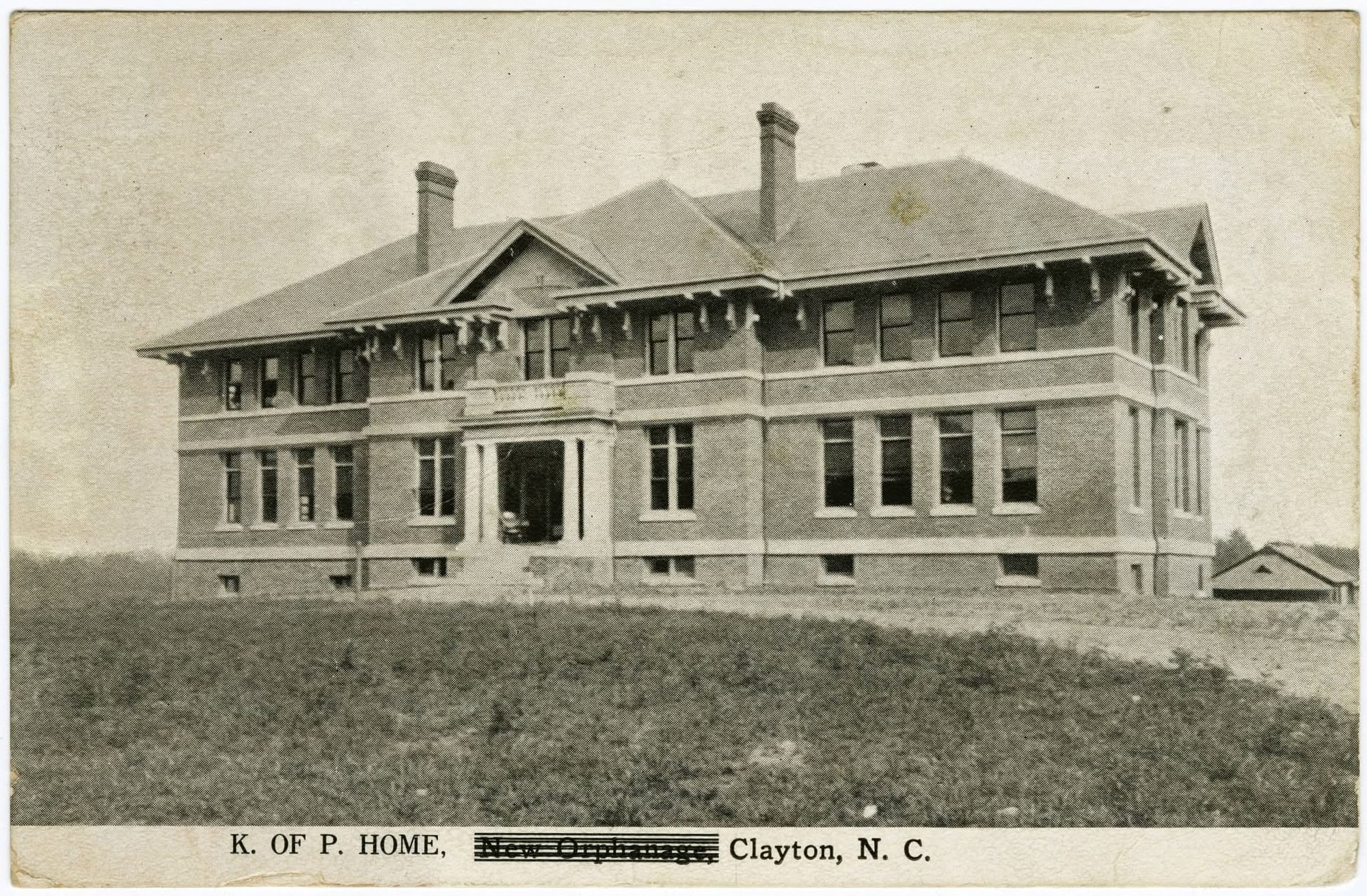
The Knights of Pythias is an international, non-sectarian fraternal organization founded in Washington, D.C., on February 19, 1864, by Justus H. Rathbone. It was the first fraternal order chartered by an Act of the U.S. Congress. The fraternal order follows three principles, Friendship, Charity, and Benevolence.
In 1936 the members of this local "Lodge No. 137, Knights of Pythias" were planning a picnic to Lake Myra on August 17th 1936. After departing Clayton at 4 PM they were planning on serving supper at 6:30.
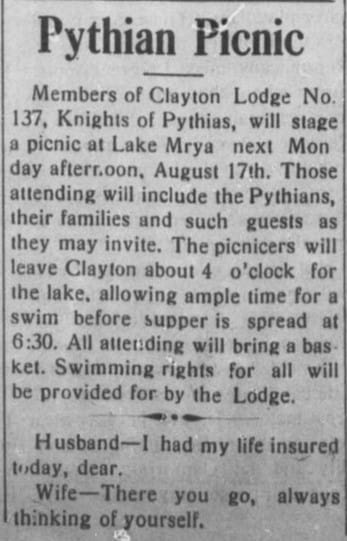
Included at the bottom of this page is a 90 year old joke. How has it aged?
Husband - I had my life insured today, dear.
Wife - There you go, always thinking of yourself.
Piggly Wiggly Advertisement
Finally, a small advertisement that caught my attention. A Piggly Wiggly August advertisement for August 1936. Canning season meant grocers could offer savings on commonly needed equipment for home canning. They also asked for baby pictures, invoking both milk products as well as Gerber's. "Fine lot we have, too"
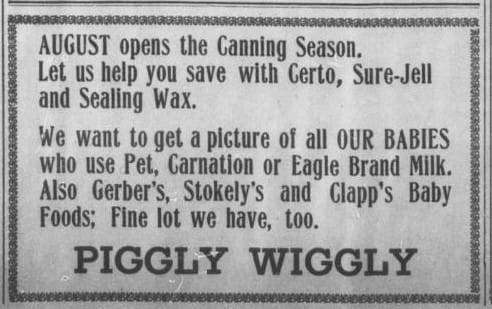
The final fun fact that I will share with you is this. The iconic charcoal sketch of the original Gerber Baby was modeled after Ann Turner Cook, drawn by her neighbor Dorothy Hope Smith in 1928. At the point this advertisement was published in 1936, 90 years ago 'the' Gerber baby would have been 9 years old.