The Weekender: The Building Formerly Known as Clayton Fitness

Good Morning, Clayton!
Holy smokes, this is a long one. Even by my “Dan is writing these things way too long” standards.
Which has actually given me an idea: I’m thinking about putting out a TL;DR version for paid subscribers.
So basically the exact opposite of everywhere else. You get the whole thing for free. But the summary is gonna cost ya.
Speaking of paid members, stickers and tote bags are officially in the pipeline!
If you want to become a paid subscriber, there’s a link at the bottom of the newsletter. And if becoming a paid member isn’t in the cards right now but you still want to help, tell a friend about The Dispatch. Seriously. That helps as much as anything.
Once again, thank you for all of the kind words, shares, emails and incredible feedback.
Now, considering the length of this thing, let's get into it.
The Dispatch Lead: The Building Formerly Known as Clayton Fitness
Clayton paid $3 million for the former fitness center and will spend millions more turning it into a new multigenerational community facility. But two years after an overcrowded senior center helped start the conversation, the Town is still working out exactly where seniors fit in.
It doesn’t take long inside the Clayton Center for Active Aging to understand the problem.
The place is bursting at the seams.
On an average day, more than 100 people come through the small senior center on Dairy Road. Some days, that number climbs as high as 130. They come to exercise, play games, make crafts, eat lunch, take classes, and, maybe most importantly, spend some time around other people.
There just isn’t enough room for all of them.
Some classes are limited to eight or 10 people simply because that’s all the space will hold. Waiting lists are common. During a visit this week, I was shown a schedule filled with programs and a room where even the number of exercise balls has to be limited because there’s nowhere else to put them.
“Someone misses out all the time,” one staff member told me.
Community & Senior Services of Johnston County Director Josh Jensen puts the problem into even starker terms. Clayton’s center now averages more than 100 participants a day. The Harrison Center in Selma averages a little more than 50 — in roughly twice the space.
So nobody really disagrees that Clayton’s seniors need more room.
And, as luck would have it, the Town of Clayton now owns nearly 20,000 square feet of it.
Last year, Clayton paid $3 million for the former Clayton Fitness building on Cameron Way. The Town has since rechristened it the Clayton Wellness and Activity Center and is planning to transform the old private gym into a public facility with fitness rooms, classrooms, a gymnasium, a demonstration kitchen, meeting space, and areas for community services.
At a recent Town Council work session, HH Architecture presented the first detailed look at what that transformation could entail.
The price to renovate the building is currently estimated somewhere between $6.4 million and $9 million. Add the purchase price, and Clayton could ultimately have somewhere between $9.4 million and $12 million invested in the property before the doors officially open.
That opening isn’t expected until early 2028.
Town officials argue that’s still a bargain compared with starting from scratch. HH Architecture estimated that a similarly sized new community center could cost between $13.3 million and $20.3 million. And in a fast-growing town already short on recreation and community space, it’s not particularly difficult to make the case that Clayton can use the building.
The more complicated question is what, exactly, Clayton is building — and for whom.
Because while the Wellness and Activity Center is being designed as what the Town calls a “multigenerational” facility for children, adults and seniors alike, the story of how Clayton ended up with the building begins, in large part, with a group of people who had already been saying for years that sharing space wasn’t enough.
Clayton’s seniors want, and need, a place of their own.
This Problem Didn’t Start With Clayton Fitness
The need for more senior space in Clayton wasn’t discovered after the Town bought a gym.
It was already becoming impossible to ignore.
In July 2024, the Johnstonian News reported that the Clayton Center for Active Aging was operating out of just 3,407 square feet on Dairy Road. On an average weekday that May, 82 people were coming through the doors. The center logged 1,811 check-ins in a single month and registered 14 new participants.
They were coming for line dancing, cardio drumming, bingo, crafts, health screenings, meals, karaoke, and a long list of other programs.
The problem was there simply wasn’t enough room for all of them.
Diana Skinner, then president of the center’s advisory board, went before Town Council that summer and asked Clayton to help find a solution. Town leaders had previously suggested that seniors could make greater use of the existing Clayton Community Center, but Skinner argued that general Parks and Recreation programming didn’t necessarily meet the needs of older adults.
What she asked for was something more specific: a larger facility tailored for seniors.
And the numbers backed her up.
A few days later, Community & Senior Services Director Josh Jensen told the Johnstonian that attendance at the Clayton center had exploded. In January 2022, the center recorded fewer than 400 check-ins. By January 2024, that number had climbed to nearly 1,600. In April, it reached roughly 1,800.
Clayton had become the busiest senior center operated by CSS in Johnston County.
It was also the smallest location.
Jensen said the building had fallen below federal minimum space requirements for senior centers and was operating under a waiver. At the time, CSS was already talking with both the Town and Johnston County about finding a larger home.
Two years later, the squeeze has only gotten worse.
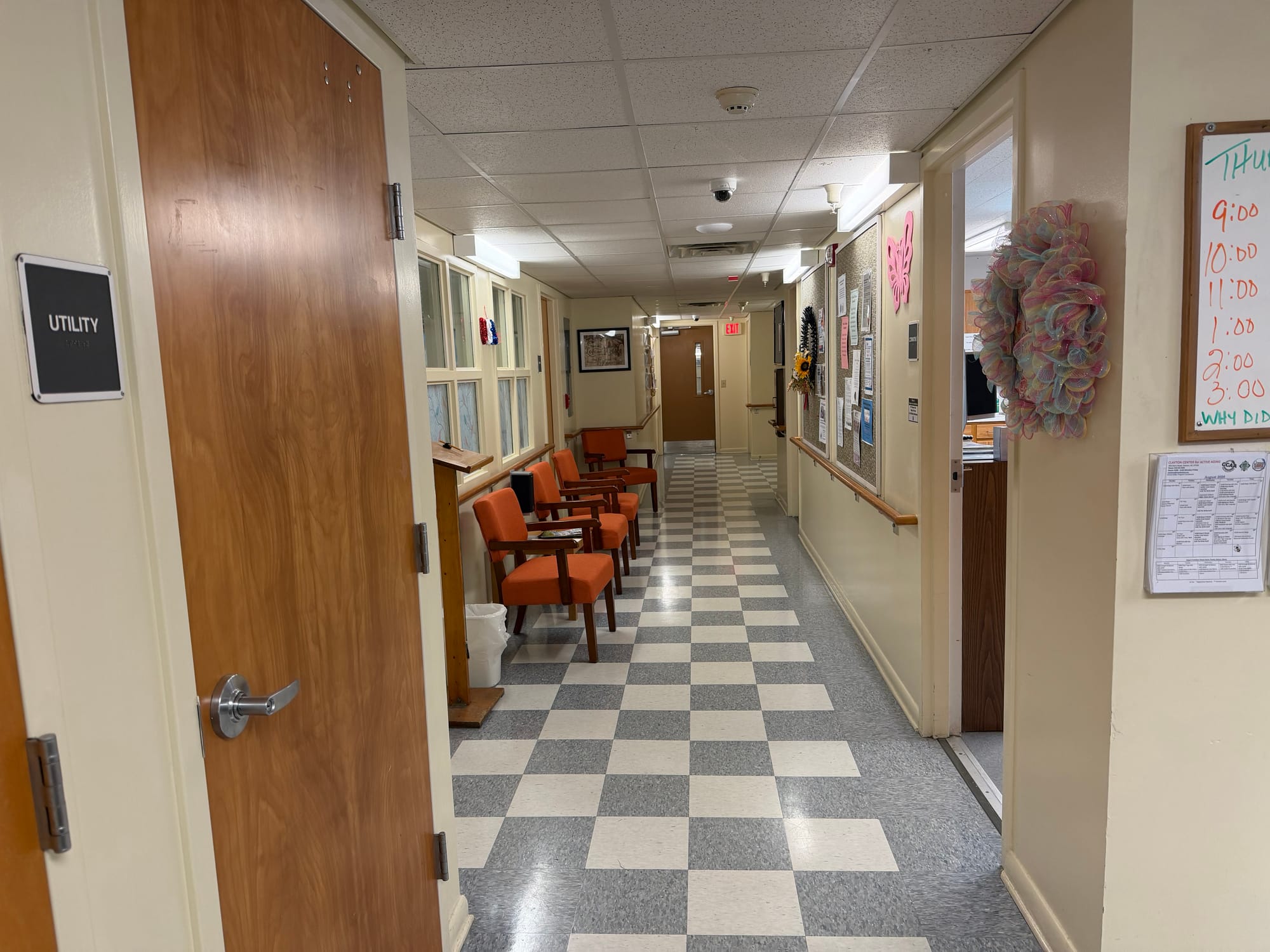
Jensen now says the Clayton center averages more than 100 participants a day. By comparison, CSS’s Harrison Center in Selma sees a little more than 50 people a day in roughly twice the space.
So by the summer of 2024, the problem was pretty clearly defined: Clayton had a rapidly growing senior population, an overcrowded center, and a community organization asking for help finding a bigger place to put it.
Then $1 million showed up from Raleigh.
And that’s where things get… let’s just say “Confusing”.
The Million-Dollar Grant
In the Town’s telling, the $1 million grant was never supposed to be just for seniors.
Clayton says it originally went to its state legislative delegation asking for $5.5 million to add roughly 7,000 square feet to the existing Clayton Community Center.
The request was broad:
“Add additional ±7,000 square feet of program, storage, and staff space at the community center to meet programming needs for youth, seniors, and families.”
The General Assembly didn’t give Clayton $5.5 million.
It gave the Town $1 million.
And somewhere between Clayton’s request and the final state budget, the description of what that money was for changed considerably.
The appropriation was listed as “Town of Clayton — Senior Community Center,” with the scope stating that the money would provide a directed grant to the Town for:
“capital improvements or equipment at the Clayton Senior Community Center.”
There was just one pretty significant problem with that.
The Town of Clayton doesn’t own the Clayton senior center. The Clayton Center for Active Aging on Dairy Road is operated by Community & Senior Services of Johnston County.
Town officials say the senior-center language was essentially a mistake.
In a July 2024 article in the Johnstonian News, Sen. Benton Sawrey said legislative staff had summarized Clayton’s request that way and that the broader purpose had gotten “lost in translation.”
Mayor Jody McLeod gave the same explanation, pointing back to the Town’s original request for space serving youth, seniors and families.
So, at the direction of Town Council, Town Manager Rich Cappola contacted Clayton’s legislative delegation and asked for what officials have consistently called a “technical correction.”
And technically corrected it was.
The new language still carried the heading “Town of Clayton — Senior Community Center,” but the scope changed to allow the $1 million to be used for:
“property acquisition, construction, capital improvements, or equipment for a community senior center or a community civic center.”
That may sound like legislative housekeeping, but it was a pretty substantial change.
The original language allowed the Town to buy equipment or make improvements at a senior center.
The new language allowed the Town to buy property, construct a new facility and, importantly, spend the money on a community civic center instead.
Town officials say that simply restored the flexibility contained in Clayton’s original request.
Not everyone saw it that way.
By the summer of 2024, the grant had already become a local controversy.
Many have both publicly and privately accused the Town and a state lawmaker of taking $1 million away from the Clayton Center for Active Aging.
Sawrey strongly disputed that characterization.
“Johnston CSS never lost $1 million,” he told the Johnstonian, noting that CSS had never been awarded the money in the first place.
That’s true. The grant was made to the Town of Clayton.
But by that point, senior advocates had spent months publicly describing an overcrowded senior center, asking Town leaders for help and specifically requesting a larger facility tailored to older residents.
Former Councilman Jason Thompson brought that argument directly to Town Council in August 2024.
Thompson acknowledged that Clayton could not simply spend public money renovating a building it did not own. But he argued that changing the language violated what he believed was the spirit of the appropriation.
“You seem to have found a loophole to use that money for other means,” Thompson told Council.
Council members pushed back.
Porter Casey said at the time that, as far as he knew, no decision had yet been made about how the money would ultimately be spent. He also made another point that has proven difficult to argue with: $1 million was never going to build the senior facility advocates were asking for.
Whatever the original intent, more money and more partners were going to be necessary.
The Town, meanwhile, was already making clear that its preferred solution would not be a traditional, single-purpose senior center.
McLeod told the Johnstonian that Clayton was unlikely to use the state money exclusively for senior purposes, arguing that the Town needed facilities that could serve its growing population across age groups.
Cappola pointed to the same philosophy Town officials still use today: multigenerational programming and flexible space.
And at that point, the former Clayton Fitness building wasn’t even part of the conversation.
The Town confirmed to The Dispatch that the property had not been identified when Clayton made its original request to the state.
That opportunity came later.
When Clayton Fitness became available, the amended grant language meant the Town now had $1 million that could legally be used toward the acquisition of a Town-owned civic facility.
Clayton bought the building for $3 million.
The grant that began life in the state budget under the words “Senior Community Center” had helped make possible what would eventually become the Clayton Wellness and Activity Center — a nearly 20,000-square-foot facility designed not just for seniors, but for everybody.
Whether that was simply the Town finally using the money the way it had originally intended, or whether something important was lost between the original senior-center language and the eventual multigenerational project, has been debated in Clayton ever since.
Rep. Donna White, who was also involved in securing the state appropriation, did not respond to questions from The Dispatch about the grant’s original intent or the subsequent change in language.
Before It Was the Wellness Center…
Long before it became the Clayton Wellness and Activity Center, and long before anyone was arguing over grants, floor plans, or exactly which generation should get which room, the building was simply Clayton Fitness.
A family-owned gym that was home to many locals’ gym life, family events, and occasional professional wrestling matches. (I met Ivan Koloff, the Rock n’ Roll Express, Demolition, and watched George South help win the NCWA tag titles in this building).
And the family behind it had already spent decades taking care of families in Clayton before the doors to the gym ever opened.
Clayton native, Dustin Parks’ grandparents, Patricia “Ms. Pat” Durham and Larry Durham, owned and operated Toddler’s Inn and Toddler’s II, two longtime Clayton daycares that generations of local families passed through.
Later, the family’s attention turned from little kids to grown-ups and health needs.
Parks said his father had always loved working out and was a member of the gym that previously operated in the space now occupied by Fit4Life. When that owner decided to sell, the family saw an opportunity.
Clayton was growing, fitness seemed like a business with a future, and it gave the family another venture they could build together.
And together is pretty much how they did everything.
“Everybody in the family at some point has worked in one or both of the businesses,” Parks said. “It’s always been a total family effort.”
The Clayton Parks remembers from those early days looked quite a bit different from the one we live in now.
“It was much less overcrowded and still very much a small town,” he said. “Back in the days when the Harvest Festival was still in the gravel parking lot and literally everyone in town knew each other somehow.”
For Parks, some of the best memories aren’t necessarily about either business itself. They’re about being part of a downtown and small-business community where everybody knew everybody.
“You could go into any local business and know most of the people in there working,” he said. “Especially as fellow business owners, there was always a sense of looking out for each other and pride in our hometown.”
That same feeling extended to the people who worked for the family.
“We were always very close with all of the employees,” Parks said. “They were basically just extended family.”
Parks hopes people remember Toddler’s Inn as a place where his grandmother emphasized early education, good values, and making sure kids had fun.
And Clayton Fitness?
He hopes people remember it as one of the best places in town to work out — somewhere everybody was welcome, and where the community mattered as much as the equipment.
There’s also a bit of poetry in what the building may become next.
Before Parks’ grandfather Larry passed away in 2022, he was a big supporter of programs like SilverSneakers, which encourage older adults to stay active and connected.
“He used to always say how good it was for seniors to have something that got them out of the house, socializing and staying active,” Parks said.
And then there was something else he liked to say:
“Someone’s got to take care of the old folks too.”
Parks thinks his grandfather would be pretty happy to see the old family gym become a place where Clayton’s seniors could do exactly that.
“I think he would really love to see the building turned into a top-notch center for seniors to use,” Parks said. “I’d love to see it become that as well. It’s such a huge building and has so much potential.”
The question now is what Clayton plans to do with all that potential.
So, What Are We Actually Building?
Fast forward two years, and Clayton finally has a much clearer idea of what it wants to do with the building formerly known as Clayton Fitness.
At a recent Town Council work session, HH Architecture presented the first detailed concept for transforming the 19,630-square-foot facility into the Clayton Wellness and Activity Center.
The plan is ambitious.
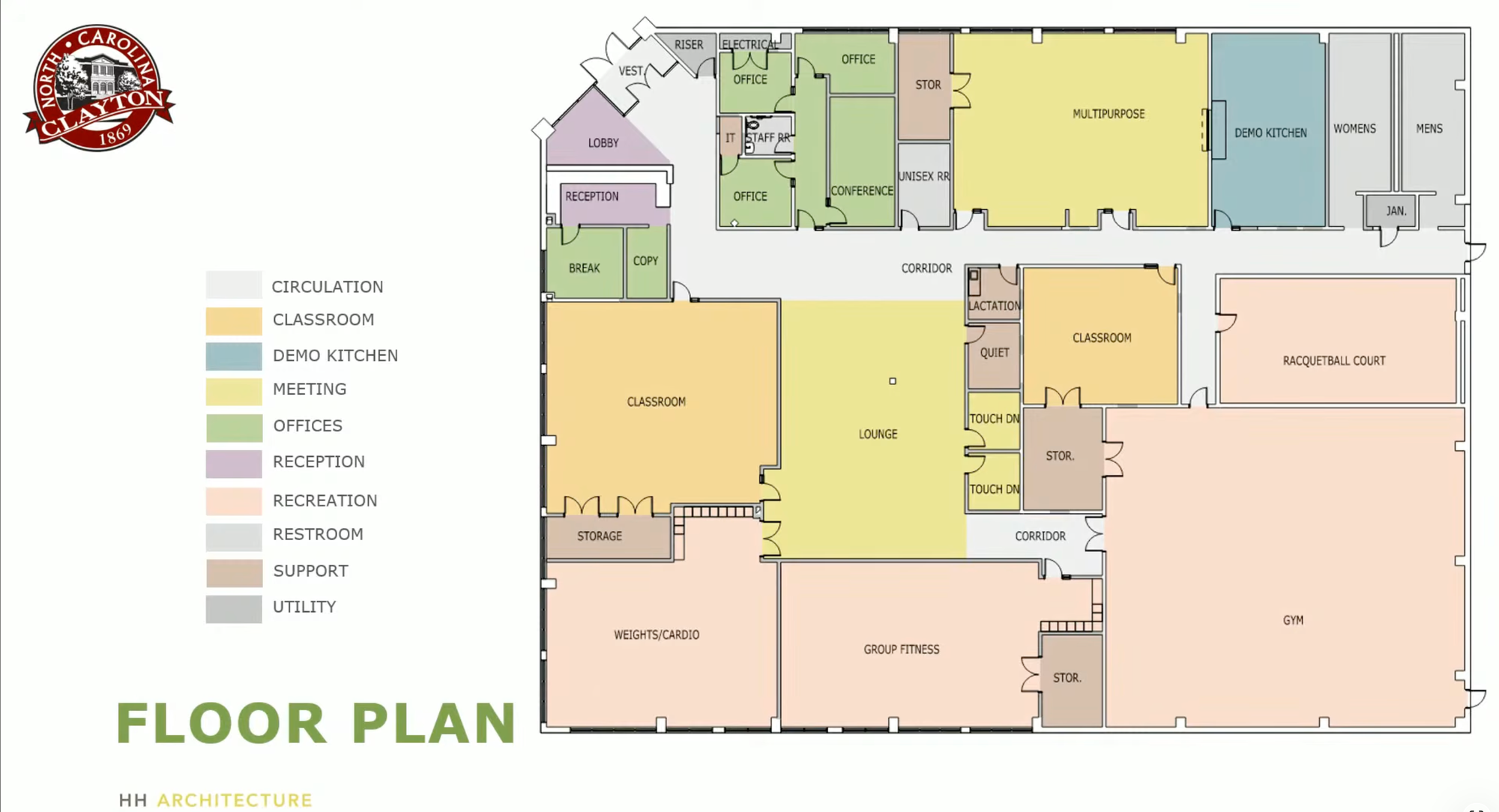
There’s a weights and cardio area, group fitness space, classrooms, a multipurpose room, a demonstration kitchen, a gymnasium, a central lounge, a quiet room for people with sensory needs, a lactation room, and a pair of small “touchdown” offices that could be used for one-on-one consultations with organizations offering services like Medicare or AARP assistance.
Parks and Recreation staff described the building as a kind of “one-stop shop” — somewhere residents could exercise, take a class, find community resources, or simply hang out with friends and neighbors. Proposed programming ranges from Zumba and line dancing to mahjong, bridge, parent-and-me classes, and inclusive programs for residents with different needs.
In other words, this is not Clayton Fitness with a Town logo slapped on the front.
It’s essentially a second community center.
And the Town has been pretty clear about the philosophy behind it.
The word officials keep using is multigenerational.
After the work session, the Town told The Dispatch that it means creating a recreation facility where youth, adults, and seniors can use the same spaces throughout the day and, in some cases, intentionally participate in programs together.
“The goal is not to design the facility around one age group,” the Town said, “but to create a community space that can support a variety of needs while also bringing generations together.”
There’s a reasonable argument for that.
Clayton’s current Community Center is already packed with programming. Parks and Recreation staff told Council that another multipurpose room could accommodate fitness classes with 50 to 60 seniors, while the additional gym space could help a youth basketball program serving more than 500 kids each season.
And flexible space is, well, flexible. A room used for line dancing in the morning can host mahjong in the afternoon and something completely different that evening.
But there was one glaring omission from the first-floor plan.
There wasn’t actually a dedicated senior space.
Staff said the building’s central lounge had been designed, in part, with older adults in mind. It would give seniors somewhere to sit, socialize, work on puzzles or play cards before and after programs. The nearby touchdown offices could host one-on-one consultations for Medicare, Social Security, AARP, and other resources.
But the lounge wasn’t a senior lounge.
It was an everybody lounge.
That distinction caught the attention of Councilman Porter Casey.
Casey reminded everyone that one of the reasons the Town had gotten to this point in the first place was the need for more senior space.
“I would like to see, I think we need to consider some options for a potential dedicated senior space in this multi-purpose facility,” Casey said.
He wasn’t asking to turn the entire building over to seniors.
He was asking for somewhere inside it that they could “kind of call home.”
That sparked a broader discussion about the existing racquetball court.
Racquetball, staff acknowledged, isn’t exactly burning up the Parks and Recreation demand charts these days. The court had originally been left largely untouched because keeping it was the cheapest option.
Council began asking whether at least some of that space might be better used as a dedicated senior area instead.
Mayor Jody McLeod agreed that the facility could serve the entire community while still preserving the purpose that helped get the project started.
“All this is fantastic,” McLeod said, “but we still want to keep the focus on seniors.”
He also asked the design team to look at another decidedly unsexy but pretty important issue: how an older resident or someone with mobility problems is supposed to get from the rear parking lot to the building’s primary entrance. McLeod asked for a cost analysis on some type of covered walkway along the side of the building.
By the end of the discussion, staff had clear direction to go back and reconsider the racquetball area with a dedicated senior space in mind.
Updated concepts are expected to return to Council this fall.
And since that meeting, the Town’s language has shifted a little too.
In a follow-up response to The Dispatch, officials said they now want to work with the Clayton Center for Active Aging to explore how “dedicated and shared spaces” inside the new facility can support senior programming.
What Does a Senior Center Actually Do?
It’d be easy to look at the Wellness and Activity Center plans and ask a reasonable question:
Why does any of this require dedicated senior space?
After all, Clayton already offers recreation programs. The new building will have classrooms, exercise equipment, and plenty of flexible rooms. Why not just schedule senior programs there and call it a day?
Because that’s not really how a senior center works.
The Clayton Center for Active Aging is operated by Community & Senior Services of Johnston County, or CSS, which provides a much broader network of services aimed at helping older adults remain active, connected, and independent.
At the Clayton location, that includes fitness classes, line dancing, cardio drumming, crafts, games, book clubs, health screenings, social events, meals, and other programs. Participants can also simply come in, spend time with friends, work on a puzzle, or use the fitness room.
All CSS programming is provided at no cost to everyone over the age of 50.
The center also connects seniors with services that go well beyond recreation.
CSS provides Medicare counseling, caregiver support, nutrition programs, transportation assistance, in-home services, and help connecting residents with other resources they may need as they age.
That helps explain why things like private consultation rooms, storage, accessible entrances, and dependable programming space matter.
A senior coming through the door might be there for line dancing in the morning, lunch at noon, and an appointment to get help navigating Medicare that afternoon.
CSS also serves daily meals for eligible seniors. Director Josh Jensen told The Dispatch that those meals are prepared off-site, meaning the new facility would not need a full commercial kitchen for CSS programming — but it would need adequate space to receive and serve them.
And then there’s the social side.
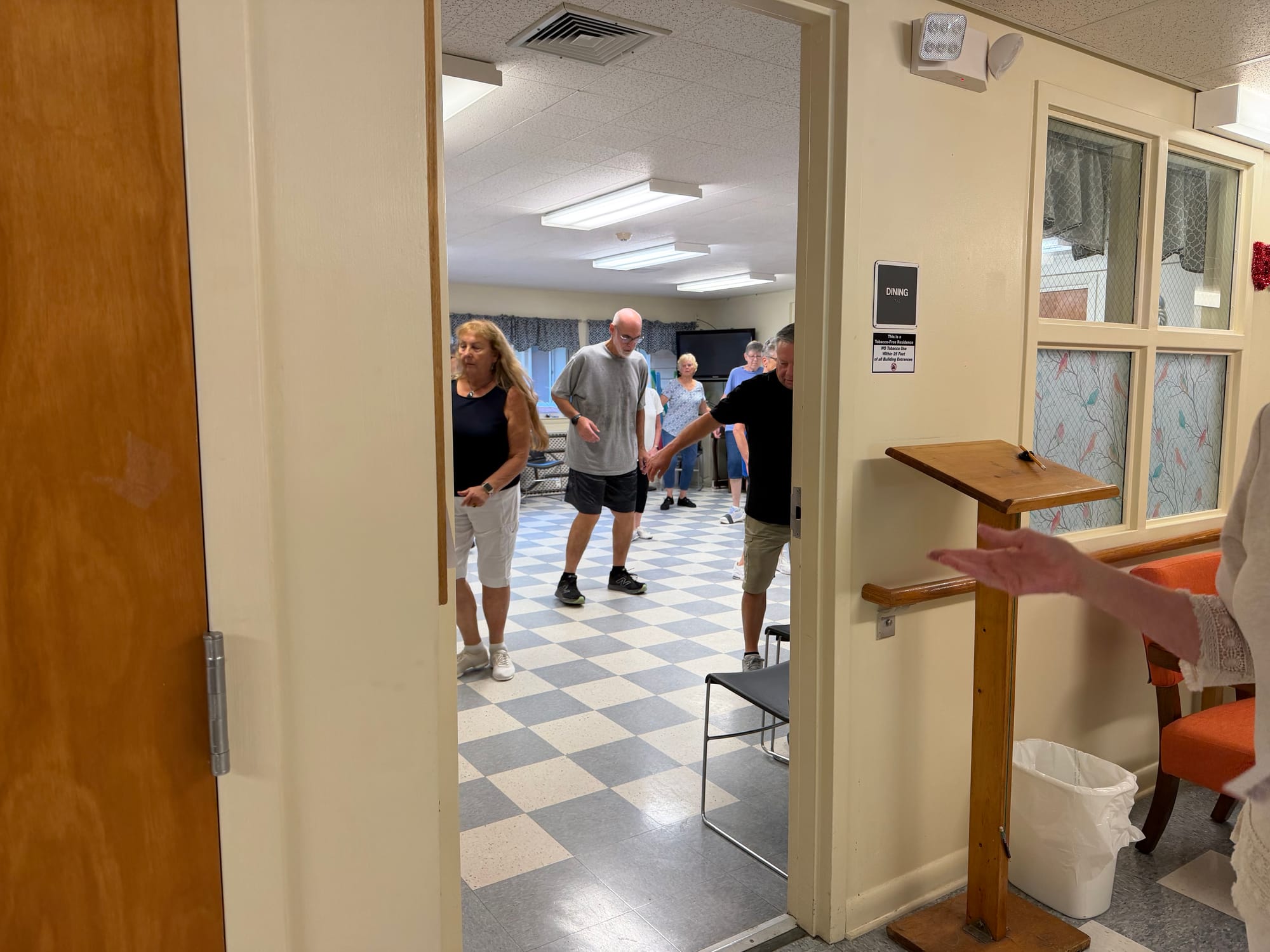
For many of the people using the Clayton center, this isn’t simply somewhere to take a class. It’s somewhere to go.
That’s the distinction that can get lost when the conversation turns to “flexible” versus “dedicated” space.
A senior center isn’t just a room where older people do activities.
It’s part recreation center, part dining room, part social club, part classroom, and part front door to a much larger network of services.
After touring the former Clayton Fitness building with Parks and Recreation staff, Jensen said the two groups had a “good dialogue” about what CSS would need to make the new location work. CSS is now preparing possible tweaks to the floor plan.
The Town, meanwhile, says it is now exploring a combination of dedicated and shared spaces for senior programming.
That may ultimately be where the two visions meet.
The question isn’t whether seniors and kids can share a building.
It’s whether Clayton can build a facility for everybody while still giving its seniors the thing they’ve been asking for all along: a place that is actually theirs.
Who Pays for All of This?
There it is. The other big question.
Where’s the money coming from?
The Town already spent $3 million to purchase the former Clayton Fitness property. The preliminary renovation estimate adds another $6.4 million to $9 million, depending on how extensive the work gets and what level of finishes and building systems Clayton ultimately chooses.
The Town doesn’t currently have all of that money lined up.
The Capital Improvement Plan includes about $4.725 million for the project. Town staff told Council that it includes roughly $2.8 million in new debt, money from Parks and Recreation fee-in-lieu funds, and about $500,000 already included for outfitting the facility.
Based on the version of the project staff believes Council is most likely to pursue, the Town is currently looking at a funding gap of about $1.5 million to $2.25 million.
There are ideas for closing it.
Town officials have discussed using unassigned fund balance, pursuing additional grants, seeking help from Johnston County, fundraising through the Parks and Recreation Foundation, and selling corporate sponsorships or naming rights for parts of the facility.
There have also been conversations about partnerships with Community & Senior Services.
But at this point, those are mostly possibilities.
During the work session, Town Manager Rich Cappola said Johnston County officials had wanted to see a clearer vision for the building before advancing conversations about a possible partnership. Now that Clayton has a preliminary floor plan and programming concept, the Town plans to continue those discussions with both the County and CSS.
There may also be opportunities to trim the price.
HH Architecture said the Town could postpone renovations to areas like the gymnasium and racquetball courts, mix lower- and higher-cost finishes throughout the building, and avoid the roughly half-million-dollar commercial kitchen option.
That gives Council plenty of knobs to turn.
But the big picture doesn’t change much.
Clayton bought the building because it appeared to be a cheaper alternative to constructing a new community center from scratch. HH Architecture estimates a comparable new facility could cost anywhere from $13.3 million to $20.3 million.
Even after adding the $3 million purchase price, renovating the former Clayton Fitness building still appears to come in well below that.
Cheaper, however, ain’t cheap.
By the time the building opens, currently projected for early 2028, Clayton could have somewhere between $9.4 million and $12 million tied up in buying and renovating the property, before getting into the ongoing cost of staffing, utilities, maintenance, and programming.
The revised design expected this fall should give Council a better idea of exactly what version of the building it wants.
Then comes the harder part: figuring out how to really pay for it.
So What Do You Think, Dan?
Well, Self, I’m glad you asked!
As many of you know, I ran for Town Council last year, and one of the biggest issues I talked about during that campaign was Clayton’s seniors.
There’s a personal reason for that.
I was incredibly close with my grandmother from the time I was born, and ultimately became one of her caretakers near the end of her life.
She was also a huge volunteer with CSS and the Clayton senior center. Twice a week, she delivered meals to homebound seniors. She drove people to doctors’ appointments, helped them run errands, and did whatever else she could through the center.
So I know firsthand how important this place is.
Which raises the obvious question:
What would I have done if I were sitting on Council when this exact situation came up?
It would be really easy for me to sit here and say I would have made sure every penny of that $1 million went toward a dedicated senior center.
But honestly?
I probably would’ve taken the money too.
I know. It’s a greasy answer.
But if I had an opportunity to turn $1 million in state funding into a nearly 20,000-square-foot public facility that could serve seniors and the rest of Clayton, I’d have a hard time walking away from it.
What I would have done from day one, though, is put CSS at the table.
My comments to Parks and Recreation would have been: This building can serve everybody, but these folks need a home in it. Figure out what they need and build around that.
And considering how good Clayton Parks and Rec is at programming, I’d trust them to knock that part out of the park.
What I wouldn’t do is pretend there wasn’t a very real senior-center need sitting underneath this whole thing.
I wouldn’t pretend that a state appropriation originally written for a “Senior Community Center” somehow had nothing to do with seniors just because the Town was technically the recipient.
And I definitely wouldn’t pretend that the Clayton Center for Active Aging hasn’t been getting the short end of the stick for years.
But I also think some of the anger over this whole mess has been aimed at the wrong government.
If I were sitting on Council, one of my first calls would be to Johnston County.
Because while Clayton argues about whether Town taxpayers should pay for a facility that also serves people who live outside the town limits, CSS is a countywide senior-services organization.
And somehow its busiest senior center has also been allowed to remain its smallest.
That’s beyond ridiculous.
And Johnston County is sitting on roughly $230 million in reserves — nearly a quarter-billion dollars.
A good chunk of that money came from taxpayers right here in Clayton.
So yes, Clayton should step up.
But put the County on a milk carton, because they appear to be missing.
If Johnston County is responsible for supporting senior services across the county, then it should absolutely have a seat at this table, and it should bring the checkbook.
The new Wellness and Activity Center actually gives everybody a pretty good opportunity to fix this.
Let Clayton build the multigenerational facility it wants.
Let Parks and Rec fill it with great programming for kids, adults, and seniors.
But give CSS meaningful, dedicated space inside it. Give Clayton’s seniors somewhere they can actually call home. And get Johnston County to help pay for the part of the building that is helping solve a countywide senior-services problem.
There’s plenty of room in that nearly 20,000-square-foot building for everybody.
We just need to make sure that “everybody” doesn’t somehow end up meaning everybody except the people who helped start this conversation in the first place.
Town Hall Watch
Joe Stallings Promoted to Deputy Town Manager
Clayton Economic Development Director Joseph Stallings has been promoted to deputy town manager, filling the position left vacant when Courtney Tanner retired in December.
Stallings started the new job earlier this week, exactly 18 months after joining the town as economic development director.
Town Manager Rich Cappola praised Stallings as a “thoughtful, strategic, and highly effective leader,” pointing specifically to his work building partnerships and managing complex economic development initiatives.
First, Stallings has quickly become one of the more visible members of Clayton’s leadership team, particularly as the Town has gotten increasingly aggressive about economic development, redevelopment, and public-private projects.
Clayton’s gotten bigger. So has Town Hall. There’s a serious question about whether those two things are happening at the same pace — or whether Town Hall’s management structure is growing faster than the town itself.
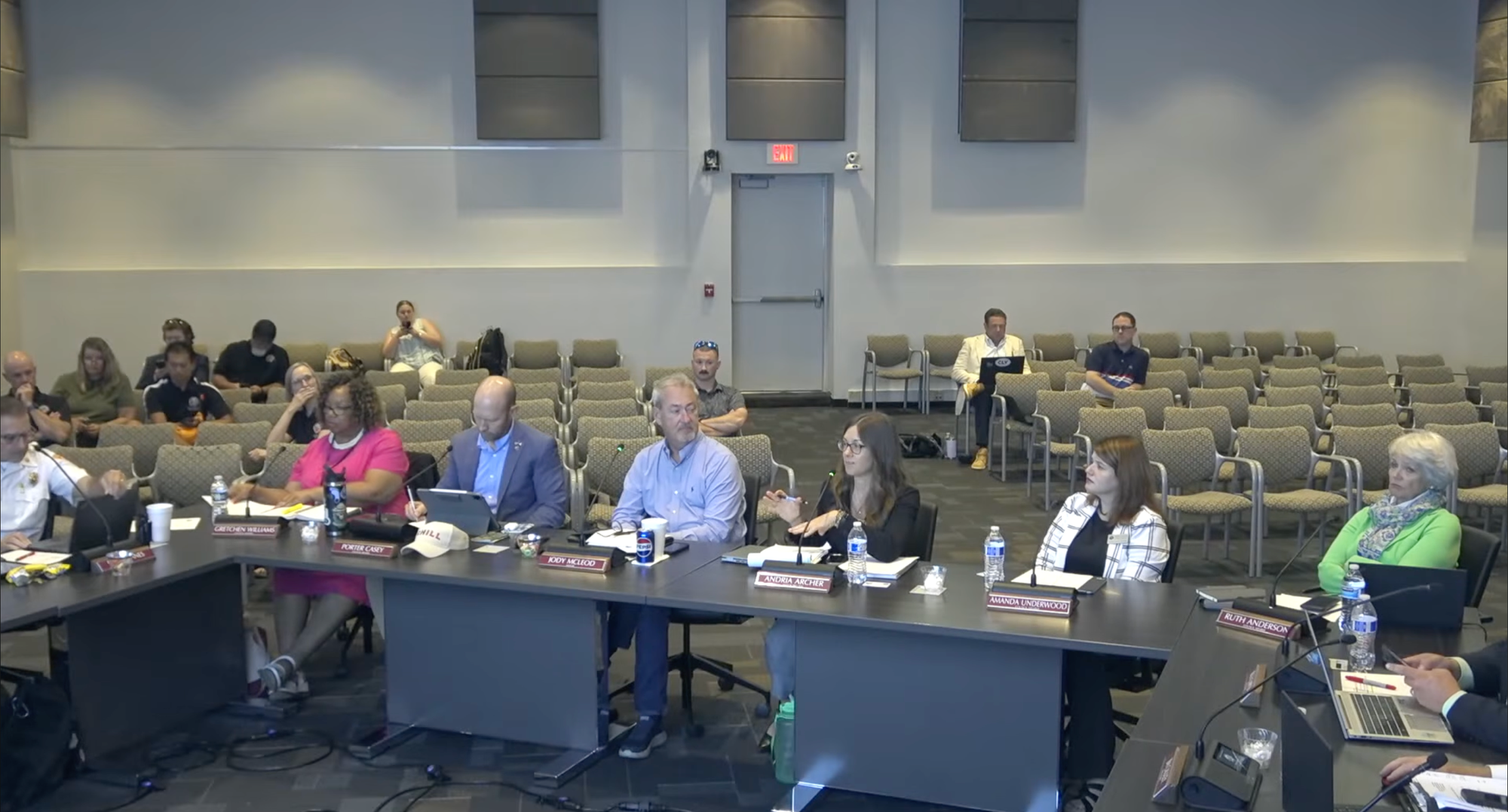
Council is back Monday
It’s a doozy of a meeting this week.
Council will consider a resolution tied to up to $70 million in future financing for the Town’s capital improvement plan. This isn’t a vote to borrow $70 million Monday night, but it does lay the groundwork for future borrowing and allows the Town to reimburse itself for eligible project costs.
The Robertson Building is back on the agenda, too. The Town is establishing a $2 million project budget, including $700,000 in grant funding and $1.3 million from the General Fund, with another project update scheduled during staff reports.
Also moving forward: a roughly $1.2 million East Main Street sidewalk contract, a $222,200 downtown public parking lot, and another step toward the proposed Bus Rapid Transit connection between Clayton, Garner, and Raleigh.
Lots of money is being spent, but at least projects are starting to move forward.
Downtown Dispatch

If you haven’t made it up to the third floor of The Station yet, Something Art Related is a place you should check out.
Resident artist Jen Kehrer has been quietly building the studio over the past few months as a place for people of all skill levels to make art without the pressure of having to be, you know, good at art.
Now she’s getting ready for a much bigger Fall/Winter Art Program, running Sept. 14 through Dec. 14, with personalized instruction for artists ages 7 and up.
Rather than a traditional class where everyone works on the same project, Kehrer tailors sessions around each artist’s interests, experience, and goals. Studio hours will be available Monday through Thursday, with everything from individual drop-ins to monthly passes offering four, eight, 12, 16, or unlimited sessions.
The bigger idea behind Something Art Related is pretty simple: **get out of the house, get off the phone, and make something. Kehrer focuses on art as a way to relax, connect with other people, and generally get out of your own head for a while.
She’s also building the studio into more than just a place for classes, with plans for guest artists, poetry readings, open mics, and other collaborative creative events.
Something Art Related is located on the third floor of The Station at 231 E. Second Street. Registration for the Fall/Winter program is open now.

Weekend Picks
A quick rundown of what’s happening around Clayton this weekend. Music, markets, food, family stuff, and anything else worth leaving the house for.

Friday
Ladida Wine Shop | Downtown Clayton
Vinyl Night with 4 Track Records | 7 pm
4 Track Records will be spinning vinyl from 7–9 pm and bringing along a curated selection of records for sale. Grab a glass of wine, dig through the crates, and settle in for an easygoing night of good music and good pours.
First Street Tavern | 115 E. First Street
Live Music with Derek Chase | 7 pm
Derek Chase takes over First Street Tavern for live music from 7–10 pm outdoors, weather permitting. If the weather moves things inside, music starts at 8 pm and runs until 11 pm.
Clayton Rocks | Downtown Clayton
Raid the Quarry | 8pm
Raid the Quarry returns to Clayton Rocks Friday night with a live set of rock and punk starting at 8 pm.

Saturday
The Cardinal | 401 E. Main Street
VanMeter | 10pm
Clayton’s own Jennifer VanMeter brings her roots-rock sound to The Cardinal Saturday night, backed by Bruce Clark, Larry Woodard and Braxton Lindsay. Think Tom Petty and The Pretenders with a little Lucinda Williams and Blackberry Smoke mixed in. VanMeter has performed everywhere from the Clayton Harvest Festival to the Key West Songwriters Festival and has shared stages with The Lone Bellow, Devon Allman, Lissie, Kasey Chambers and Robyn Hitchcock. Music runs from 10 pm–1am.
Heart2Hands Art Gallery & Studios | 472 E. Second Street
Vibrant Sunset Painting Class | 11am
Learn how to create a vibrant, glowing sunset using oils or acrylics in this beginner-friendly painting class. Bring your own reference image and supplies; all experience levels are welcome.
Revival 1869 | 222 E. Main Street
Paul Bomar Quartet | 8 pm
Settle in for a Saturday night of live jazz with the Paul Bomar Quartet at Revival 1869, playing from 8–11 pm.
Sunday
A NICE SUNDAY AFTERNOON IN DOWNTOWN CLAYTON
No big plans required. Here’s your game plan for a nice, lazy Sunday in downtown Clayton.
Start with a bevvie from BLVD — we recommend the Dirty Poppi Soda special — then wander down Main Street for a little shopping at Odd One Out and/or Bexley House before heading to Aaktun for brunch.
From there, take your time making the downtown rounds. Pop into White Rabbit, see what’s going on at Elixir VI, browse Grit & Chime, and swing through Clayton Rocks.
Then call it a day with a glass of wine and dessert at Ladida Wine Shop.
And because we’re apparently planning your entire Sunday now: bring a DD.
Also on Sunday
Pottery Camp | 12973 US 70 Bus
Glass Fusing Class
Design your own one-of-a-kind glass piece while learning the basics of cutting, arranging, and fusing glass. Choose from projects including a candy dish, bowl, votive, or lantern panel, then Pottery Camp will kiln-fire and shape your finished piece for pickup within a week. Plan on about 1½–2 hours to complete your project.
One Good Thing
Every week, we're going to try and end on a positive note. Snapshots of Clayton history, local legends, monumental ackomplishments in the community, and more. This section is supposed to make you feel good.

A GOOD START TO THE SCHOOL YEAR
Going back to school is expensive. OneCompassion is trying to make it a little easier for local families.
On Tuesday, Aug. 18, the Downtown Clayton nonprofit is hosting a completely free Back-to-School Bash from 5–8 pm at 114 W. Main Street.
There’ll be free dinner, games, a bounce house, and plenty of stuff for the kids, but the really good part is what families will be able to take home: 300 hygiene bags, free haircuts, fairy hair, and other back-to-school resources to help local students start the year feeling ready.
A whole bunch of local businesses are pitching in, too, including Harvestlore Homestead, Squeeze the Day Lemonade, Stark Rentals, Romeo’s Pizza and Genlo Balloons, along with a visit from the Clayton Fire Department.
It’s free, it’s open to everybody, and it’s a bunch of people in Clayton coming together to make the first day of school a little better for some kids.
That’s a good thing.
Quick Note - OneCompassion has no relationship with The Clayton Dispatch. Paid or otherwise. We just think this is a really good thing that they're doing.
Become a Paid Clayton Dispatch Member
$5 per month or $50 per year Membership helps support independent local reporting, expand coverage, and pay for future Dispatch upgrades.
Members receive:
- The ability to comment on Dispatch stories
- Priority question submissions for the upcoming Council Watch-Along with Dan podcast
- Regular behind-the-scenes reporting notes and project updates
- Member discounts and early access to Clayton Dispatch merch
- An exclusive Clayton Dispatch sticker for monthly members*
- An exclusive Clayton Dispatch tote bag for annual members.

The actual reporting will remain available to everyone. Paid membership helps make more of it possible.
Also, this can get us a whole lot closer to a print edition.
*Stickers will be given out every quarter.